
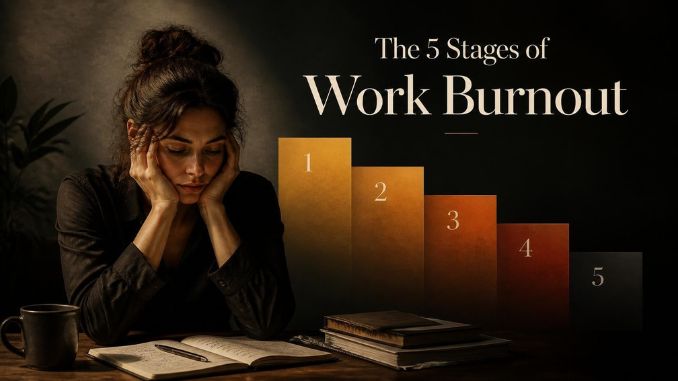
You already know something is wrong. Maybe it’s the Sunday dread that arrives earlier every week. Maybe it’s the fact that the work you used to love now feels like a sentence. Maybe you’re functional on the outside — answering emails, showing up to meetings, keeping it together — but something underneath has quietly gone dark.
Work burnout doesn’t happen overnight. It moves in stages, and most people don’t recognize which stage they’re in until they’ve already been there for months. That delay matters, because the CBT techniques that help someone in Stage 2 are very different from what someone in Stage 4 actually needs.
This guide is designed to help you figure out exactly where you are — and what cognitive behavioral therapy does at that specific point in the progression.
? Stage 1: The Overachiever Trap (Compulsive Drive)
Stage 1 doesn’t feel like burnout. It feels like ambition. You’re energized, productive, and deeply committed. You volunteer for extra projects. You’re the first one on the Slack thread in the morning and the last one off at night. For Chicago professionals in the Loop, River North, or West Loop — where 60-hour weeks are quietly normalized — Stage 1 can go unnoticed for years.
The trap is that this stage feels good. Your identity and your output have merged. Work isn’t something you do — it’s who you are.
? Recognize It: Stage 1 Signs
- Compulsive overworking that feels voluntary — not forced
- Neglecting rest, relationships, or hobbies without noticing
- Measuring your worth entirely by productivity
- Feeling vaguely uneasy when you’re not working
- Dismissing self-care as something you’ll get to “once things settle down”
What most people do wrong at Stage 1: Nothing — because it doesn’t feel wrong. That’s what makes Stage 1 the most dangerous phase. The behaviors that seed burnout are being rewarded with promotions, praise, and a sense of purpose.
What CBT does here: This is the intervention most people never get, because they never think to seek help at Stage 1. CBT at this stage focuses on values clarification — separating who you are from what you produce — and cognitive restructuring around productivity-based self-worth. A therapist will help you examine the core beliefs driving compulsive overwork: “If I’m not producing, I’m failing.” These aren’t character strengths. They’re cognitive distortions waiting to compound.
Perfectionism is almost always present at Stage 1. If you recognize yourself here, our Chicago erfectionism therapy page explores how those patterns develop and what structured treatment looks like.
? Stage 2: The Cracks Appear (Onset of Stress)
Stage 2 is when reality starts pushing back against Stage 1’s momentum. The enthusiasm is still there — but something feels off. Sleep isn’t as restorative. The Sunday dread arrives. You’re more irritable than usual. You find yourself snapping at a partner or colleague over something small and wondering why it hit so hard.
Most people in Stage 2 attribute this to a particularly stressful quarter, a difficult project, or not getting enough exercise. They’re not wrong that those things contribute — but the real driver is the cumulative cost of the compulsive drive in Stage 1 finally coming due.
? Recognize It: Stage 2 Signs
- Difficulty falling asleep or waking up at 3am with a racing mind
- Sunday anxiety that bleeds into Saturday afternoon
- Shorter fuse than usual — disproportionate irritability
- Forgetting things you normally track easily
- Starting to skip the activities that used to restore you
- A vague but persistent sense of falling behind, even when you’re not
What most people do wrong at Stage 2: They push harder. The logic is intuitive — if I’m falling behind, I need to work more. But this is the first major fork in the burnout path, and taking the wrong road here accelerates the progression significantly. Doubling down on output at Stage 2 is pouring fuel on a fire you haven’t yet identified as a fire.
What CBT does here: Stage 2 is the ideal intervention point. CBT at this stage focuses on thought records — identifying the automatic thoughts driving the stress response (“I can’t slow down or everything will fall apart”) — and behavioral scheduling, which means deliberately re-introducing recovery behaviors rather than waiting until you feel ready for them. A CBT therapist will also help you audit your language: how many “musts,” “shoulds,” and “have-tos” are running your workday? These aren’t motivational — they’re pressure systems.
At this stage, the anxiety-burnout connection is also worth examining. Our post on the burnout-anxiety-depression triangle explains why these three often travel together — and why treating only one rarely works.
? Stage 3: The Brownout (Chronic Stress)
Stage 3 is where most Chicago professionals live for months — sometimes years — without ever naming it as a problem. You’re still functional. You’re still showing up. Deadlines are still getting hit. But something fundamental has shifted.
You’ve become cynical. The work that used to feel meaningful now feels like theater. Colleagues you liked now feel like liabilities. The small annoyances of office life — the pointless meeting, the chain of reply-alls, the reorganization that changes everything and nothing — now feel genuinely intolerable. You’re not depressed exactly. You’re just… flat.
? Recognize It: Stage 3 Signs
- Persistent cynicism and emotional detachment from your work
- Productivity is maintained but satisfaction is gone
- Physical symptoms: headaches, GI issues, frequent colds, muscle tension
- Social withdrawal — canceling plans has become your default
- Escapist behaviors: more drinking, more scrolling, more hours lost to nothing
- Feeling like you’re watching yourself work from a slight distance
What most people do wrong at Stage 3: They normalize it. “Everyone feels this way.” “This is just what having a real job feels like.” The cynicism that’s a symptom of burnout becomes a worldview — and that worldview makes seeking help feel pointless. Why bother? Nothing will change.
What CBT does here: Stage 3 requires a dual approach. The first target is behavioral activation — systematically re-engaging with activities that produce meaning and pleasure, even when motivation is completely absent. Burnout has drained the reward system; behavioral activation primes the pump. The second target is the cynicism itself — the cognitive distortions that have calcified into worldview: “My work doesn’t matter,” “Nothing I do makes a difference,” “Everyone here is incompetent.” These thoughts feel like clear-eyed realism. CBT helps you examine whether they’re actually accurate — or whether they’re the voice of a nervous system in chronic overload.
Work burnout at Stage 3 also routinely spills into personal relationships. Our post on how work burnout shows up in relationships covers the specific patterns that develop here.
? Stage 4: The Wall (Full Burnout)
Something breaks. It might be dramatic — a panic attack in a Lakeview conference room, a breakdown in your car in the parking garage, a moment of rage that shocks you with its intensity. Or it might be quiet: you sit down to start a task you’ve done a hundred times, and you simply cannot begin. The engine won’t turn over.
Stage 4 is the stage most people think of when they hear the word “burnout.” By this point, the depletion is total — physical, emotional, and cognitive. The strategies that kept you functional through Stages 2 and 3 have stopped working.
? Recognize It: Stage 4 Signs
- Complete emotional exhaustion — no reserves left
- Inability to concentrate on even simple tasks
- Feeling empty, hollow, or detached from your own life
- Physical collapse: chronic illness, sleep disruption, pain
- Sense that you’ve permanently changed — that you used to be capable but no longer are
- Anxiety and depression symptoms appearing together or alternating
What most people do wrong at Stage 4: They take a vacation, sleep for a week, and try to return to the same environment that produced the burnout. The physical rest is necessary — but without structural change and clinical support, the conditions that drove the progression are still intact. Stage 4 resolved with rest alone almost always cycles back.
What CBT does here: Stage 4 requires a full clinical assessment before any technique work begins. A CBT therapist needs to understand the complete picture: what drove the progression through each stage, which cognitive patterns are most entrenched, whether anxiety or depression is co-occurring, and what the person’s actual life looks like — not just their work life. From there, CBT provides a structured path that includes pacing (reintroducing activity gradually and sustainably), schema work on identity beliefs tied to productivity, and relapse prevention planning so that recovery doesn’t mean returning to Stage 1 conditions.
At Stage 4, structured treatment matters. Our work burnout therapy page walks through what that treatment actually looks like in practice — from your first session through recovery. That’s a different resource than this post: where this guide helps you understand the stages, that page is about what working with a therapist involves.
? Stage 5: The New Normal (Habitual Burnout)
Stage 5 is the most quietly devastating of all — because the suffering has become invisible, even to the person experiencing it. You’ve been burned out for so long that you’ve stopped noticing it. The depletion isn’t a crisis anymore. It’s just Tuesday.
People at Stage 5 have often reorganized their entire identity and daily life around managing exhaustion rather than recovering from it. They’ve stopped planning things to look forward to. They’ve drifted away from friendships. They’ve made their world smaller without realizing it. This is sometimes misdiagnosed as depression — and while depression is often present, the root is a nervous system that has been in chronic overload for so long it’s forgotten what baseline feels like.
? Recognize It: Stage 5 Signs
- Burnout symptoms feel like personality traits, not symptoms
- You’ve stopped imagining a different way of living
- Numbness has replaced both stress and satisfaction
- Relationships feel like obligations rather than connections
- You function, but can’t remember the last time you felt genuinely well
- The idea of “recovering” feels abstract or naive
What most people do wrong at Stage 5: They accept it. The hopelessness that’s a symptom of Stage 5 gets mistaken for accurate perception of reality. “This is just who I am now.” It isn’t. But Stage 5 has a way of erasing the evidence of a different self — the version of you that had energy, curiosity, or a reason to look forward to Monday.
What CBT does here: Recovery from Stage 5 is slower and more scaffolded than earlier stages — but it is real, and it happens. CBT at this stage works at the schema level, addressing deeply held beliefs about work, worth, and identity that have been reinforced for years. It also involves rebuilding what psychologists call a valued life — clarifying what actually matters to this person (separate from productivity and achievement) and constructing a sustainable path toward it. This is long-term work, and it’s worth it. The 10-session structure of our Pathfinder 10 Program was specifically designed for this kind of systematic, workbook-based recovery.
?️ Why Knowing Your Stage Changes Everything About Treatment
Burnout isn’t one thing. It’s five different things wearing the same name, and treating Stage 1 the same way you treat Stage 5 is one of the most common reasons people don’t recover — or recover temporarily and then slide back.
? Stage-to-Treatment Quick Reference
| Stage | Core CBT Focus |
|---|---|
| 1 — Compulsive Drive | Values clarification, identity-productivity separation |
| 2 — Onset of Stress | Thought records, behavioral scheduling, language audit |
| 3 — Chronic Stress | Behavioral activation, cognitive restructuring of cynicism |
| 4 — Full Burnout | Full assessment, pacing, schema work, relapse prevention |
| 5 — Habitual Burnout | Long-term schema therapy, valued life rebuild, Pathfinder 10 |
One more thing worth naming: burnout at any stage rarely travels alone. Research consistently shows it co-occurs with generalized anxiety, depression, and — particularly for high-achievers — perfectionism. If you recognized yourself in multiple stages, or if the anxiety piece feels as prominent as the exhaustion, that overlap is worth addressing directly in treatment. Our post on 10 reasons work burnout is worse now than it’s ever been provides broader context for why so many Chicago professionals are navigating exactly this right now.

❓ Frequently Asked Questions About the Stages of Work Burnout
Can you be in more than one stage of burnout at the same time?
Yes — and this is actually common. Most people experience the later stages while still carrying unresolved patterns from earlier ones. Someone in Stage 4 full burnout often still has the Stage 1 compulsive-drive beliefs running in the background, which is part of what makes recovery complicated. CBT addresses the current-stage symptoms and the underlying beliefs simultaneously.
How long does each stage of burnout typically last?
There’s no fixed timeline — burnout progression depends heavily on the intensity of the work environment, individual coping patterns, and whether the person gets support. Stage 1 can last years. Stage 2 often lasts months before most people notice it. Stage 3 (chronic stress) is where people most commonly stall, sometimes for a year or more, before crossing into Stage 4. The length of time spent in earlier stages also affects how long recovery takes.
Is burnout the same as depression?
They overlap significantly — especially at Stages 4 and 5 — but they’re not identical. Burnout is rooted specifically in occupational exhaustion and disconnection; depression involves broader anhedonia, hopelessness, and neurobiological changes that may or may not be work-related. The two commonly co-occur, and CBT is effective for both. A clinical assessment is the right way to understand what’s actually present.
Can you recover from Stage 5 burnout?
Yes — though recovery from Stage 5 takes longer and requires more sustained support than earlier stages. The most important step is refusing to accept habitual depletion as a permanent identity. Stage 5 has a way of making recovery feel naive or impossible; that belief is a symptom, not an accurate read of your capacity to change. Many people who have spent years in Stage 5 have rebuilt genuinely sustainable lives through structured CBT treatment.
What’s the difference between stress and burnout?
Stress is characterized by urgency — you feel like too much is being demanded of you, but you still believe things can improve if you just get through the pressure. Burnout is characterized by emptiness — the belief that nothing you do will make a difference, and the emotional reserves to keep trying have dried up. Stress can actually drive performance; burnout consistently degrades it. The two exist on the same continuum, which is why early-stage intervention matters.
How does CBT for burnout differ from just taking time off?
Time off addresses the physical depletion — it restores sleep, reduces cortisol, and creates space. But it doesn’t touch the cognitive patterns, core beliefs, or behavioral habits that drove the burnout in the first place. Most people who recover through rest alone return to the same Stage 1 conditions within weeks. CBT provides the structural and psychological change that makes recovery durable rather than temporary.
Can burnout happen even when you love your job?
Absolutely — and this is one of the most disorienting forms of burnout. Loving your work provides no immunity from the physiological effects of chronic overload. In fact, passion can accelerate burnout progression by making Stage 1 overcommitment feel virtuous rather than risky. Mission-driven professionals — teachers, healthcare workers, nonprofit staff, first responders — are among the most vulnerable to burnout precisely because their emotional investment makes overextension feel justified.
When should I consider therapy for work burnout?
The honest answer: earlier than feels necessary. Most people reach out at Stage 4, when they’re in crisis. But Stage 2 is the optimal intervention point — when the patterns are visible but haven’t fully compounded. If you recognized yourself in any of the descriptions above and the symptoms have been present for more than a few weeks, that’s a reasonable threshold for reaching out. Early-stage CBT is significantly shorter and more efficient than late-stage recovery work.