
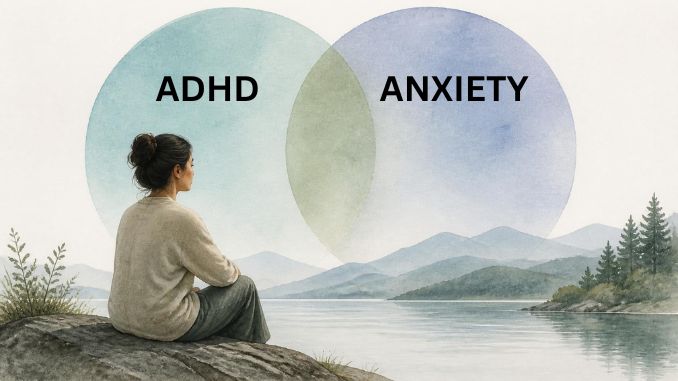
You’ve been in therapy for anxiety for two years. You’ve learned the techniques, done the work, made real progress. And yet — there’s still something that isn’t budging. The missed deadlines. The task avoidance. The way time disappears. The exhaustion of holding it together at work while your brain runs three conversations at once.
Or maybe it went the other way: you got an ADHD diagnosis, started building systems, found strategies that helped. And yet the anxiety — the chronic low hum of dread, the catastrophizing when something goes wrong, the paralysis before important tasks — never really lifted.
If either of those sounds familiar, there’s a clinical reason. ADHD and anxiety co-occur in roughly 50% of adults with ADHD. They are deeply intertwined conditions that share mechanisms, amplify each other, and — critically — require different treatment considerations when they show up together. Treating one without addressing the other is often why therapy stalls.
This is one of the most under-addressed issues in adult mental health treatment.
Most therapists who treat anxiety don’t specialize in ADHD. Most ADHD coaches don’t treat anxiety. The overlap — where both conditions live simultaneously — is exactly where Calm Anxiety Clinic’s approach is designed to work. Learn more about our adult ADHD therapy →
❓ The Numbers: How Common Is the ADHD–Anxiety Overlap?
The research on ADHD and anxiety comorbidity is consistent and significant:
- Approximately 50% of adults with ADHD also meet criteria for an anxiety disorder
- Adults with ADHD are 3–7 times more likely to develop an anxiety disorder than adults without ADHD
- Generalized Anxiety Disorder (GAD) is the most common anxiety disorder co-occurring with ADHD in adults, followed by social anxiety and panic disorder
- The presence of both conditions is associated with greater functional impairment than either condition alone
These aren’t rare edge cases. If you have ADHD, the odds that anxiety is also part of your clinical picture are essentially a coin flip. And yet the two conditions are routinely treated separately — often by different providers who aren’t communicating with each other.
❓ How ADHD Creates Anxiety
ADHD doesn’t just co-occur with anxiety randomly. For many adults, the ADHD comes first — and the anxiety develops as a direct consequence of living with ADHD in a world that wasn’t built for how your brain works.
The mechanism is straightforward and painful:
- ADHD causes real, repeated failures — missed deadlines, forgotten commitments, underperformance, social missteps caused by impulsivity or inattention
- Each failure generates shame, self-criticism, and fear of future failure
- That fear becomes anticipatory anxiety — dread before tasks, avoidance of situations where failure is possible, hypervigilance around performance
- The anxiety then makes the next ADHD challenge harder — avoidance compounds time blindness, shame compounds task initiation difficulty
- Over years, the pattern solidifies into something that looks and feels like a permanent character flaw, not a treatable neurological condition
This is why so many adults with ADHD describe their anxiety as feeling different from “regular” anxiety. It’s often tightly tethered to performance, productivity, and self-worth — because it grew directly out of years of ADHD-related struggles.
ADHD-driven anxiety often looks like perfectionism.
When ADHD causes repeated failure, many adults respond by developing extremely high standards — a compensatory strategy to prevent the next mistake. The result is perfectionism that looks like high achievement from the outside but feels like paralysis from the inside. Treating the perfectionism without the ADHD underneath it rarely produces lasting change.
❓ How Anxiety Makes ADHD Worse
The relationship runs in both directions. Anxiety doesn’t just emerge from ADHD — it actively worsens ADHD symptoms in ways that create a compounding cycle.
Anxiety impairs the same executive functions that ADHD already compromises:
- Anxiety floods working memory with threat-monitoring and worst-case scenarios — leaving less cognitive bandwidth for the planning and task management that ADHD already makes difficult
- Anxiety drives avoidance — which directly reinforces the task initiation problems at the core of ADHD
- Anxiety heightens emotional reactivity — amplifying the frustration, overwhelm, and emotional dysregulation that ADHD already produces
- Anxiety creates rigidity — making it harder to shift flexibly between tasks, a transition difficulty that ADHD also causes independently
The result is an adult whose ADHD symptoms appear far more severe than they would be without anxiety in the picture — and whose anxiety is far more treatment-resistant than it would be without ADHD driving new failures that confirm anxious predictions.
If you’re curious how this plays out specifically in time management and daily productivity, our post on ADHD time management strategies for Chicago professionals breaks down exactly how the anxiety loop compounds time blindness and avoidance.
❓ The Misdiagnosis Problem: When Anxiety Hides ADHD
There’s another layer to this that often goes unaddressed: for many adults — particularly women — ADHD was never diagnosed because anxiety was diagnosed first.
Anxiety and ADHD share overlapping surface presentations. Both can cause:
- Difficulty concentrating and sustaining attention
- Restlessness and difficulty settling
- Sleep problems
- Avoidance of demanding tasks
- Irritability and emotional dysregulation
When a clinician sees these symptoms and anxiety is present, it’s natural to attribute everything to the anxiety — especially when the patient presents as intelligent, articulate, and apparently high-functioning. The ADHD underneath goes unidentified. Anxiety treatment is provided. Some things improve. Others don’t, and nobody is sure why.
This diagnostic gap is particularly common in adults who developed strong compensatory strategies early — the ones who worked twice as hard as everyone else to produce the same output, who appeared to be managing fine until the demands of adult life exceeded their ability to compensate.
If anxiety treatment has helped but left a persistent layer of struggle — it’s worth asking whether ADHD is also part of the picture.
Our adult ADHD therapy in Chicago is designed for exactly this situation — adults who have done real work on their anxiety and are ready to address what’s underneath.
⚖️ ADHD-Driven Anxiety vs. GAD: What’s the Difference?
Not all anxiety in adults with ADHD looks the same — and the distinction matters for treatment. There are two distinct anxiety profiles that commonly present alongside ADHD:
ADHD-driven anxiety is secondary — it develops as a response to the real-world consequences of ADHD. It tends to:
- Be tightly linked to performance, productivity, and specific ADHD failure points
- Reduce significantly when ADHD symptoms are effectively managed
- Feel more like shame and dread than pure physiological anxiety
- Be activated by specific triggers (deadlines, transitions, open-ended tasks) rather than pervasive and free-floating
Generalized Anxiety Disorder (GAD) co-occurring with ADHD is a primary condition in its own right. It tends to:
- Involve pervasive, difficult-to-control worry across multiple life domains — not just performance
- Persist even when ADHD is well-managed
- Include physical symptoms — muscle tension, fatigue, sleep disruption — more consistently
- Respond to anxiety-specific CBT interventions independent of ADHD treatment
Many adults with ADHD have elements of both. Understanding the distinction is clinically important because the treatment priorities differ — and getting it wrong means targeting the symptom rather than the source.
For a deeper look at Generalized Anxiety Disorder as a standalone condition, our GAD treatment page covers what it looks like and how CBT addresses it specifically.
❌ Why Treating One Without the Other Fails
This is the clinical crux of the issue — and the reason so many adults with ADHD and anxiety feel stuck despite genuine effort in treatment.
When you treat anxiety without addressing ADHD:
- CBT strategies for anxiety require follow-through, organization, and consistent practice — all of which ADHD directly undermines
- The real-world ADHD failures that generate anxiety keep happening, continuously feeding new material into the anxiety cycle
- Cognitive restructuring can challenge anxious thoughts, but if the feared outcomes (missing deadlines, underperforming) keep occurring due to untreated ADHD, the restructuring doesn’t hold
- Progress plateaus — some things improve, but a stubborn layer of struggle remains
When you treat Attention Defecit without addressing anxiety:
- Anxiety-driven avoidance actively sabotages ADHD strategies — the person knows what to do but can’t get started because the emotional barrier is still intact
- Shame and self-criticism from years of ADHD struggles continue driving the avoidance cycle even after ADHD skills improve
- Panic and acute anxiety episodes derail the routine and consistency that ADHD management depends on
- The internal experience remains exhausting even when external functioning improves
Treating one condition at a time is like bailing out a boat without fixing the leak.
Progress happens, but the underlying source of the problem keeps refilling what you’ve cleared. Integrated treatment that addresses both ADHD and anxiety simultaneously is what actually changes the pattern — not more strategies layered on top of an unaddressed foundation.
❓ The CBT Approach to ADHD and Anxiety Together
Cognitive Behavioral Therapy is uniquely well-suited to treating ADHD and anxiety simultaneously because it addresses both the thought patterns and the behavioral patterns that maintain both conditions.
In integrated CBT for ADHD and anxiety, treatment typically works across several simultaneous tracks:
- Executive function scaffolding — building external systems that reduce the ADHD-driven failures that generate new anxiety
- Cognitive restructuring — targeting the shame-based beliefs that developed over years of ADHD struggles (“I’m broken,” “I’ll never change,” “I always do this”) and the catastrophic predictions that anxiety generates about future performance
- Exposure work — gradually confronting the task avoidance that both ADHD and anxiety drive, using graduated behavioral experiments rather than willpower
- Emotional regulation — building skills to tolerate the distress that ADHD creates without it triggering the anxiety spiral
- Behavioral activation — structured scheduling that creates momentum and reduces the paralysis that ADHD and anxiety together produce
The sequence matters. Effective integrated treatment doesn’t just run two treatment protocols in parallel — it addresses the interaction between ADHD and anxiety, targeting the specific points where each condition amplifies the other.
For adults where burnout is also in the picture — which is common when ADHD and anxiety have been unaddressed for years in a demanding work environment — burnout recovery becomes a third treatment thread that runs alongside the other two.
❓ What Integrated ADD and Anxiety Treatment Looks Like at Calm Anxiety Clinic
At Calm Anxiety Clinic in Lakeview, our adult ADHD therapy is built on the understanding that ADHD and anxiety need to be treated as an integrated clinical picture — not sequentially, not separately, but together.
Your therapist will conduct a thorough intake to understand how ADHD and anxiety are interacting in your specific situation — which is driving which, where the cycles are most entrenched, and what the highest-leverage treatment targets are.
?️ The Pathfinder 10 Program
Our structured 10-session, workbook-based CBT program is particularly effective when both ADHD and anxiety are present — because the external structure of the program reduces executive demands while building skills for both conditions simultaneously. You always know where you are, what you’re working on, and what comes next. Learn more about Pathfinder 10 →
We offer in-person sessions at our 3354 N. Paulina St. Lakeview office, and telehealth throughout Illinois for clients whose schedules make consistent in-person attendance difficult. We accept Blue Cross Blue Shield PPO. We also have an office location in Andersonville.
❓ Frequently Asked Questions: ADHD and Anxiety
- How common is it to have both ADHD and anxiety?
- Very common. Research consistently shows that approximately 50% of adults with ADHD also meet criteria for an anxiety disorder. Adults with ADHD are 3–7 times more likely to develop an anxiety disorder than adults without ADHD. The two conditions are so frequently intertwined that any comprehensive ADHD assessment should routinely screen for anxiety, and vice versa.
- Did my ADHD cause my anxiety, or are they separate conditions?
- Often both. For many adults, anxiety develops as a direct consequence of years of ADHD-related struggles — repeated failures, shame, and anticipatory dread about future performance create anxiety that is secondary to the ADHD. For others, both conditions are present independently. A thorough clinical intake can help clarify the relationship between them in your specific situation, which matters for how treatment is sequenced and prioritized.
- Why did anxiety treatment help but not fully fix things?
- If you treated anxiety without identifying ADHD, the underlying source of many of your anxious triggers — the real-world failures and executive function struggles that feed the anxiety cycle — kept happening. CBT for anxiety can restructure anxious thoughts, but if the feared outcomes keep occurring due to untreated ADHD, the restructuring doesn’t fully hold. Addressing the ADHD removes the engine that keeps generating new anxiety.
- What’s the difference between ADHD-driven anxiety and GAD?
- ADHD-driven anxiety tends to be tightly linked to performance and specific ADHD failure points — it often reduces when ADHD is effectively managed. GAD is a primary condition characterized by pervasive, difficult-to-control worry across multiple life domains, physical symptoms like muscle tension and fatigue, and persistence even when ADHD is well-managed. Many adults with ADHD have elements of both, which is why integrated assessment and treatment matters.
- Can CBT treat both ADHD and anxiety at the same time?
- Yes — and for adults with both conditions, integrated CBT is typically more effective than treating each condition separately. CBT addresses both the executive function deficits at the core of ADHD (through behavioral strategies and external scaffolding) and the thought patterns and avoidance cycles that maintain anxiety. Treating both simultaneously targets the interaction between the conditions, not just the symptoms of each in isolation.
- How do I know if I have ADHD, anxiety, or both?
- The surface presentations overlap significantly — both can cause concentration difficulties, restlessness, avoidance, and sleep problems. A thorough clinical assessment by a therapist familiar with both conditions is the most reliable path to clarity. Many adults begin therapy for anxiety and discover ADHD is also part of the picture; others start with an ADHD diagnosis and find that anxiety requires its own targeted work. Therapy can proceed while the clinical picture becomes clearer.
- Do I need a formal ADHD diagnosis to get treatment for ADHD and anxiety together?
- Not at Calm Anxiety Clinic. Many adults begin CBT for ADHD symptoms before receiving a formal diagnosis. If you recognize the patterns described in this post — and if prior anxiety treatment has left a persistent layer of struggle — therapy can begin immediately while you pursue a formal evaluation through your physician or psychiatrist.
- Does Calm Anxiety Clinic accept insurance for ADHD and anxiety treatment?
- We accept Blue Cross Blue Shield PPO. Coverage varies by individual plan — we recommend contacting your provider to confirm your mental health benefits before your first session. Private pay options are also available.
❓ Ready to Address Both?
If you’ve been working on anxiety for years and something still isn’t moving — or if you have an ADHD diagnosis and the anxiety underneath it has never fully been addressed — adult ADHD and anxiety therapy at Calm Anxiety Clinic may be exactly what’s been missing.
Contact us today to schedule your first session. In-person at our Lakeview office. Telehealth throughout Illinois.
Calm Anxiety CBT Therapy Clinic
3354 N. Paulina St., Suite 209
Chicago, IL 60657
Ph: 773.234.1350